
 Council Testifies on SCI Report
before the Assembly Higher
Education Committeee
February 25, 2008
To the Honorable Patrick Diegnan, Chairperson, the Honorable Pamela Lampitt, Vice-Chair and the Honorable Assemblypersons Addiego, Carroll, Countinho, Giblin, Merkt, Oliver, Rumpf, Smith and Voss
Thank you for the opportunity to share our thoughts and concerns today. We represent a coalition of higher education unions representing over 14,000 academic employees at New Jersey’s State Colleges and Universities. The State’s Commission of Investigation (SCI) report on New Jersey’s public higher education institutions has provided a unique opportunity to correct many of the 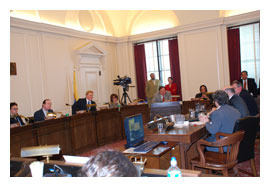 problems that were created when New Jersey abolished the Department of Higher Education and granted NJ’s public Colleges and Universities greater autonomy in 1994. Our goal here today is not to attack the institutions where our members are employed. It is to offer our perspective on the SCI Report and to endorse many of the SCI executive summary findings. We are also recommending what we believe are additional measures that will improve public accountability and strengthen our public higher education institutions.
For years, many of us have warned the Legislature that the absence of central oversight of our system of public higher education was detrimental to sound governance and public accountability. On October 25, 2007, the State’s Commission of Investigation confirmed our warnings. In a scathing report, triggered by the scandals at the University of Medicine and Dentistry (UMDNJ), the SCI found “the entire system vulnerable to waste, abuse and violations of the public trust” and recommended “comprehensive structure change” to correct these problems.
Management’s response to the SCI report was predictably cool. According to press reports, Darryl Greer, Executive Director of the New Jersey Association of State Colleges and Universities has rejected the SCI’s findings and instead pushed for a general obligation bond to pay for campus construction projects as the solution to the ballooning debt load. He also stressed that lean state budgets have forced the colleges and universities to borrow.
However, the SCI report identifies unregulated borrowing as the problem, not the solution. For example, last March, Kean University issued another $275 million in bonds, causing Moody’s Investment Service to downgrade its rating. Rowan University has just discovered that it cannot sell its bonds and will be forced to pay drastically higher interest rates on its sizable debt. Our coalition certainly agrees that the State budget continues to shortchange higher education. We believe that increased state support for higher education is essential, but only if strict controls are placed on how the institutions raise and spend the money.
If the Legislature and the Governor assume more control over how our institutions are managed, it stands to reason that you should be more willing to increase appropriations.
The SCI focused on practices at UMDNJ, Rutgers University, New Jersey Institute of Technology (NJIT), Rowan University and Ramapo College, but its findings reveal that there is a “complete absence of any mechanism to ensure internal accountability, independent external oversight and proper transparency” at all senior institutions. In startling confirmation of our worst fears, the report disclosed “virtually unrestrained borrowing practices that have saddled New Jersey’s public colleges and universities with some of the heaviest long-term higher education debt loads in the nation.” As a result of this shocking example of fiscal irresponsibility, 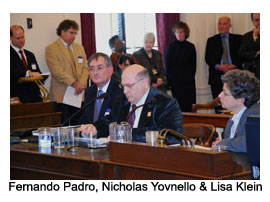 “New Jersey now ranks among the states with the highest average four-year cost of public college tuition and fees in the nation.”
The root cause of the crisis is plain to see. The report takes direct aim at State’s “wholesale disengagement from higher education,” occurring in 1994 when Governor Whitman abolished the Department of Higher Education and along with it “all meaningful elements of state involvement in safeguarding the taxpayer’s sizable investment in the system.” Since then, our public institutions of higher education have become “islands unto themselves” accountable only to local Boards of Trustees who are oftentimes little more than political appointees. The bitter fruit of this system of institution-based governance has been the “excessive intrusion of politics, including millions of dollars in lobbying expenditures, efforts to solicit state college and university officials for campaign fundraising and influence peddling…” The report further documents “instances in which the boards “through action or inaction, exercised questionable due diligence through inappropriate delegation of authority and/or failure to keep abreast of matters carrying fiscal or operational consequences.”
The SCI’s recommendations are compelling:
- Elevate the Commission on Higher Education into the Governor’s cabinet and empower it with the authority to ensure effective governance and administration.
- Revamp the process by which state college and university trustees/governing boards are appointed and provide them with more rigorous training.
- Create a statewide master plan and enforce a due diligence requirement for all capital improvement projects and for the issuance of bonds.
- Create a Task Force on Higher Education to define and codify state college and university charters in the context of public policy and sound academic practice.
The SCI report further recommends new legislation that would (1) subject all state colleges and universities to rigorous and uniform standards governing financial management and internal controls” modeled after the federal Sarbanes-Oxley law and (2) require the New Jersey Educational Facilities Authority to review the financial probity of bond sales it facilitates on behalf of the state colleges and universities.
Although the report does not recommend the restoration of the Department of Higher Education, it does forcefully advocate that institutional autonomy should exist only within a framework of effective State oversight, accountability and transparency.
In addition to the SCI recommendations, our coalition proposes the following:
- Require public higher education institutions to report detailed budget and financial information to the Commission on Higher Education and grant the Commission greater authority to exercise oversight.
- Provide more vigorous exercise of the Commission’s existing responsibilities under N.J.S 18A:3B-14 (a), (f) (g), 34. B., 35, 65-33.1, 34, et al.
- Empower the Commission to impose limits on the number of management employees and salaries of upper management at the state colleges/universities.
- Expand the Commission staff to enable it to carry out its enhanced responsibilities.
- Require that the new State Comptroller’s Office employ or dedicate at least one staff person responsible for reviewing the financial records of the state colleges/universities.
- Require that performance evaluations of presidents, provosts and deans be conducted at each institution. Elements of this evaluation should include:
- Leadership Institutional Management
- Leadership Institutional Representation
- Relationship with Faculty and Staff
- Educational Statesmanship
(We have attached a sample evaluation that clarifies the four areas listed above.)
Require boards of trustee and governors meetings to be more open. Comments from the bargaining agents, public and faculty groups are currently severely restricted. The campus bargaining agents should be provided ample opportunity to address each action item on the agenda as it comes up for discussion by the board and there should be a general comment period for any group to bring any issue it feels relevant to the board’s attention. Business meetings of the boards should not be conducted off campus and committee meetings of the boards should be open. The public rarely, if ever, sees committee decisions that are voted on by the full board. Any details of committee decisions are left out.
Passage of a bill to place two employees, chosen by campus unions, on all state college/university boards of trustees/boards of governors to provide additional oversight from an employee perspective.
We know that with every year comes a new budget crisis. However, the fact that our public institutions of higher education are mismanaged to one extent or another should not be used as an excuse to cut their budgets. Under the current governance structure, this will only result in layoffs or tuition increases, as presidents and boards of trustees will scramble to preserve their pet programs, new construction projects and sometimes bloated managerial payrolls. What we believe are needed are targeted appropriations — to fully fund the salary and benefits account, to hire more full-time faculty, to catch up on deferred maintenance, to increase Tuition Aid Grants, to ensure professional and equitable treatment to part-time/adjunct faculty, etc.
The SCI Report paves the way for a needed major overhaul of public higher education. We urge you and your legislative colleagues to seize the opportunity and act now, before further damage is done. Our coalition stands ready to work with you to correct the errors of the past and to bring a new and better era to public higher education in New Jersey — one that gives the State a leading role in shaping higher education policies by treating our state colleges and universities as a proper public trust.
Thank you.
Nicholas C. Yovnello, President - Council of New Jersey State College Locals - AFT
Lisa Klein, President - Rutgers AAUP-AFT
Fernando Padro, Vice President - NJ State AAUP

